


A nine day tour through Chiapas
Chiapas is a Mexican state in the southern part of the country, bordering the Pacific Ocean and Guatemala. It is rich in Mayan culture, indigenous languages and archeological sites. It’s also known for weavings, textiles, embroidery and handicrafts.
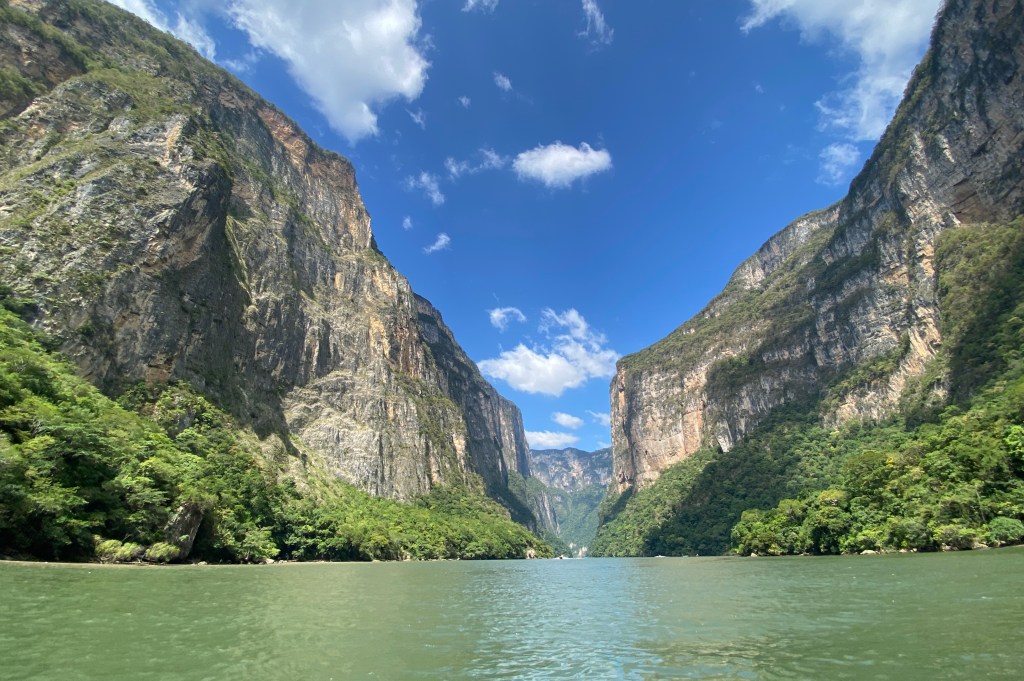
We visited Chiapas for nine days with our three children (ages 14, 12 and 10) and my mother-in-law during November. My husband’s work wouldn’t allow us to travel on our own, so we had a detailed itinerary, which we booked with a guide and we had a driver and van the entire time. I hadn’t booked an organized tour in about two decades, so it was new to me to not entirely knowing what was up and when! I had done a little research but then sort of thought, they are the experts and they know the safe places to go so I’ll leave it to them. I did feel we missed out on a few things, so you can learn from my regrets.
Chiapas is a mountainous highland and filled with rainforests and waterfalls. You can hear many native languages still being spoken, in fact most of the guides or tour operators told us Spanish was their second language. For safety reasons (many times the roads are blocked due to protests or other security issues) it is good to travel with a guide. We were recommended two tour operators by friends. One was Ileana, +52 967 679 0758 on WhatsApp. Or Carlos Diaz, +52 961 139 8905, which is who we went with as our friend who knows our children really well and has camped with us, recommended him.
Booking with Carlos was easy, all done via WhatsApp. I did some of the hotels (his recommendations) myself so we could get a refund if we needed to cancel last minute. I did all the booking in Spanish, he speaks a little English. He never asked if we wanted a driver in English and I didn’t think to ask as, well, my name is quite English! So our driver only spoke Spanish (he was very good and quite helpful) but they do have drivers who speak English, French, Italian and German, so do ask beforehand! The driver was more of a driver and less of a guide. He did think outside the box and offered different ideas to what had been planned (due to rain, our children’s abilities or whatever) but he wasn’t telling us the history as we went along.
So here is our nine-day itinerary and some of the things I would change, or we were glad had changed, as we go along day-by-day.
Day 1
Fly into Tuxtla. We were picked up and the muggy heat hit us immediately. That said, we really wore everything we brought and you do need one of everything (puffer coat, rain coat, light fleece/hoodie, short and long sleeved, lightweight pants or shorts, one heavy pants, good walking shoes, strap-on sandals or water shoes, bathing suit, hat). We managed to take just one of everything and in carry-ons only.
We had breakfast at Cafe de Chiapas (kind of like a Mexican Denny’s maybe?) and it fit the bill for being plentiful and fast with good variety. Then we were driven to a boat launch. At first glance we had no idea what we were getting into. It was mayhem. There seemed to be nobody around and yet we had to wait for many boats. And the launch looked like a rather inauspicious little bit of lake to go around. However, once we got on the speed boat, it ended up taking us up Cañon del Sumidero, on a river that snaked through the large canyon walls that go up to one kilometer high. We saw crocodiles sunbathing, the highest point of the canyon wall where the indigenous peoples jumped to their death rather than be taken by the Spanish, and a Christmas tree of greenery made from a waterfall. So we were pleasantly wrong about what we thought was in store for us! We had a really good time on the boat.
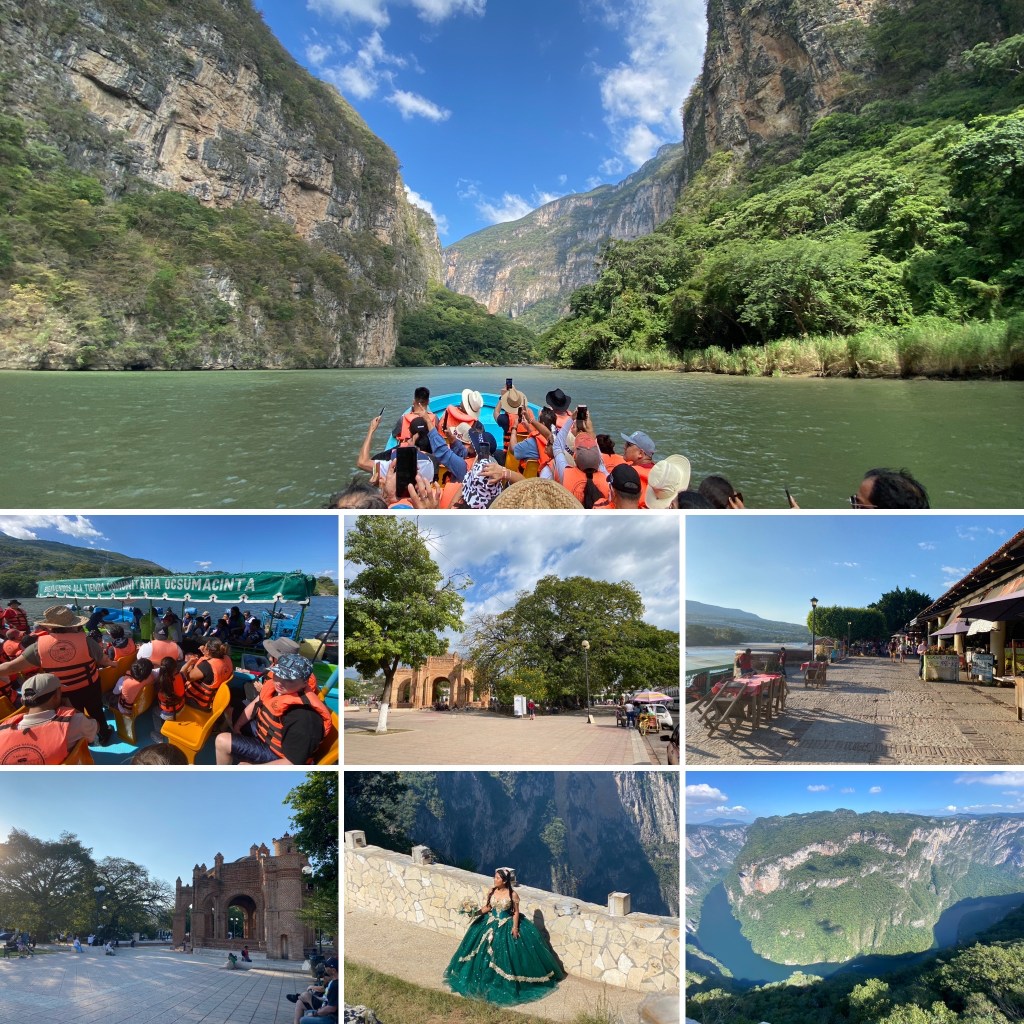
And at the end, there is a floating bar where you can get a michelada de mango (mine was poured by a 12-year-old I believe!) The boat ride was about two hours, we went from 12:30-2:30 p.m. and it was a good time to go as the sun was overhead. You also get to see the emblem of Chiapas on the coat of arms as it’s the two canyons with the river in the middle. We all had a great time on the boat (tour in Spanish) and it was nice to be on a boat after an early morning flight. Tickets ranged in price from $290 (adult) $235 (seniors and children 3-11 years old) or private boat rides from $2,500 to $4,000 pesos.
After the boat ride we were taken to the pueblo magico town of Chiapa de Corzo on the same river, Rio Grijalva, which has a main square with the pretty white Santo Domingo de Guzman church, outdoor markets ringing the square, the sacred ciaba tree and the Fountain La Pila from the 16-Century. We were taken to the Jardines de Chiapa Restaurante, which had a Mexican buffet or you could order off the menu. None of us really enjoyed our meals and we felt it was really expensive for what it was. Then we walked down one block and realized there was a malecon boardwalk along the river with al fresco dining all along, with a lively atmosphere, fresh breeze and music.
That night we stayed the Marriott Tuxtla. The outdoor pool was very beautiful, but not heated so it was chilly in the evening in November. The other adults and my eldest liked the gym.
Day 2
One of the best meals of the whole trip (as rated by the children) was the Marriott breakfast buffet. I have to say, as buffets go, it was pretty impressive.
We needed to change our Day 2 plans as they were originally to go to Sima de las Cotorras and the Aguacero waterfall but we knew our younger two children couldn’t handle these activities. The Sima involves rappelling and the waterfall had close to 800 steps (though we would realize afterwards maybe this was doable afterall). Also my friend said her husband was frightened by the rappelling on the first one, so maybe it’s not just kids who get scared!
We left Tuxtla at 9:30 am. Some alternative options were the local zoo, Rancho El Encanto (farm) or Cascada de Chorreadero (which had bad water levels when we were there). In the end our driver said that we didn’t really have a day in the pueblo magico of San Cristobal de las Casas, and a lot of people liked San Cris, so we went with his suggestion.
First we went to the 5 Miradors, which is in Parque Nacional Cañon del Sumidero, a national park which goes to the top of the canyon we had been on the first day. We went to a few of the lookouts, Mirador La Coyota, Mirador El Tepehuaje, and Mirado Los Chiapa. At the last one there was a cafe, gift shop, bathrooms and playground. It also had the best view from the outdoor second floor of the gift shop. It was about $58 pesos pp.
By 11:30 a.m. we were heading to San Cristobal. We walked around the town, the beautiful main square and along the pedestrian streets. We also went to the covered market around the Templo de Santo Domingo de Guzmán church (in retrospect I should have bought what I liked here as the selection was vast, the workmanship on the items was really good and the prices were decent). The kids and my mother-in-law ate at Jack Rock y Chela for burgers which was really good, with craft beer and excellent live music.
We had a great afternoon flat white coffee and chocolates at Xocolattes y Cafe.
My husband and I had reservations for later in the night at a restaurant called Chef Claudia Santiz, who used to work at Pujol in Mexico City. Her cooking was local, interesting and delicious. We were the only ones there. I would recommend going while you are there.
On our way back we walked past the yellow Cathedral which had an outdoor evening market which was really interesting to see.
I really enjoyed San Cristobal de las Casas, it was a higher altitude, so it was fresh and cool (pretty cold in the evening) and it reminded us a little bit of small cities we visited a long time ago in Ecuador or Peru. I quite liked the feel of it and I think if you didn’t want to go on a 9-day guided trip of Chiapas, there would be enough day trips to do from San Cris, and how lovely to come back every evening to a really nice hotel (there are loads of them) and eat a nice meal outside on a patio. I would, however, do an organized tour even if just a day trip. Our driver was in constant communication with the office and the next town we were going to, to determine safety. As well, there is limited to zero cell phone coverage so it would be difficult to navigate or get out of trouble (car break down etc) if you were doing it on your own and especially with a family in tow.
We stayed at Gran Barrio Hotel which was great. Very comfortable, lots of room and nice hot showers. We were on the ground floor, which was outside the breakfast area so it was noisy in the morning (guests, not the kitchen) so I’d ask for the second floor.

Day 3
We had such a delicious breakfast the next morning at at Xnich. The hot chocolate was rich and delicious, the pancakes were made from scratch, oatmeal was steel cut oats and the huevos rancheros were perfect. We were all very happy! It was about $70 pesos pp. We ended up in the middle of a parade (this seems to keep happening to us!) and by 10 a.m. we were finally on the road.
We drove about half an hour to the town of Chamula — a town ornate, brightly coloured houses which our driver said the local indigenous peoples love and in fact we didn’t see this style elsewhere on our travels. The locals have herds of sheep which they use for the lady’s fuzzy black wrapped skirts. We saw one lady moving them across the street and the sheep had muzzles on them. Roberto, our driver, told us they do this because if the sheep eats some grass along the way that belongs to another person, the sheep herder will be fined by the owner of that bit of grass. There was also a fine for parking too close to town, of $500 pesos, so we were dropped off near the church. The church building looked like a typical church on the outside, but we were told we weren’t allowed to take photos inside. My in-laws visited Chiapas over 30 years ago and also came to Chamula and my father-in-law did in fact take photos, and then afterwards when they were in the main plaza they were pickpocketed and robbed of bags, a purse and a camera. Coincidence? not sure, but if so, take heed!
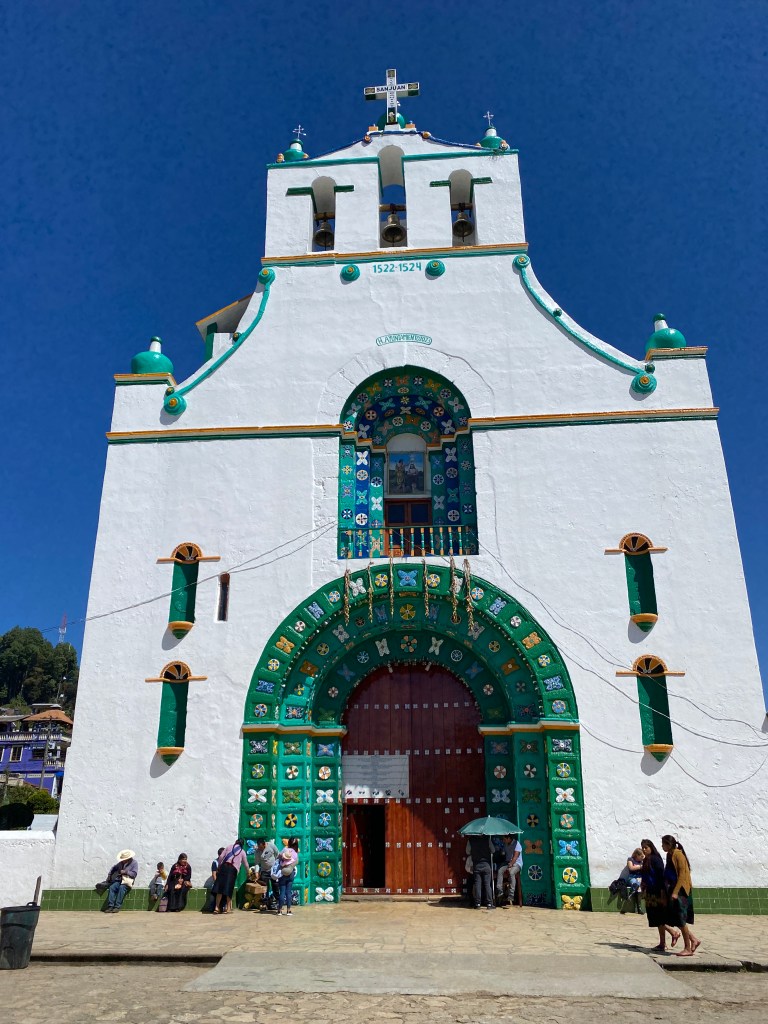
Inside the building there are no pews, but wooden trestle tables in rows around the perimeter of the church. They looked like rectangular tables you would find in a Canadian farmhouse. They were covered in bouquets of flowers, lit candles and photos. The floor was covered in inches high of fresh, green pine needs. The walls were black with soot and huge swaths of fabric were strung from the ceiling like the inside of a tent. There was a murmur of soft voices and while there were a few tourists, maybe ten of us, everyone was walking around very respectfully. There were hundreds of candles lit on the tables, on benches and in smooth circles on the tiled floor surrounded by a circle of pine needs. The little candles on the floor were in different colors and lit in a small row of maybe six candles, which were stuck to the ground with their own wax. A local was kneeled before the candles, praying or drinking coca cola. As the candles melted and formed wax puddles, the flames went out and the person would leave the puddle of wax and walk away, and a caretaker would come along with a trowel and scrape up all the wax and cover the bare floor with fresh needles. Families came into the church carrying boughs of greenery, flowers, bottles of coke and huge boxes with holes and carried with string handles — there were live chickens in the boxes. We did see a dead chicken off to one side. There was another family with their candles lit and they were sitting in a semi-circle and they brought out their live chicken and rubbed it all over the back of a teenage boy. After they did this, two women quickly and quietly rung the chicken’s neck. The mayordomo is like the priest of the church, and we bought little cloth figures of him from children in the square. When the mayordomo sees the first rainbow of the year over the church, that determines the colours of the candles used for the year. They also had pozol, a local drink made from cocoa and corn.
Unfortunately I didn’t realize there is also a market in Chamula, we were there on a Monday but our driver said the market is on Sunday so it would have been great to have been there for that.
After Chamula we did a short drive to Zinacantan where we visited two homes where we could see handmade embroidered clothing, try on typical dress, try homemade tortillas and posh/pox (a local alcoholic drink). We have done similar things in other countries and we more felt like we were visiting a storefront, and less someone’s home. It was nice to see the tortillas being made and to sample them hot off the comal.
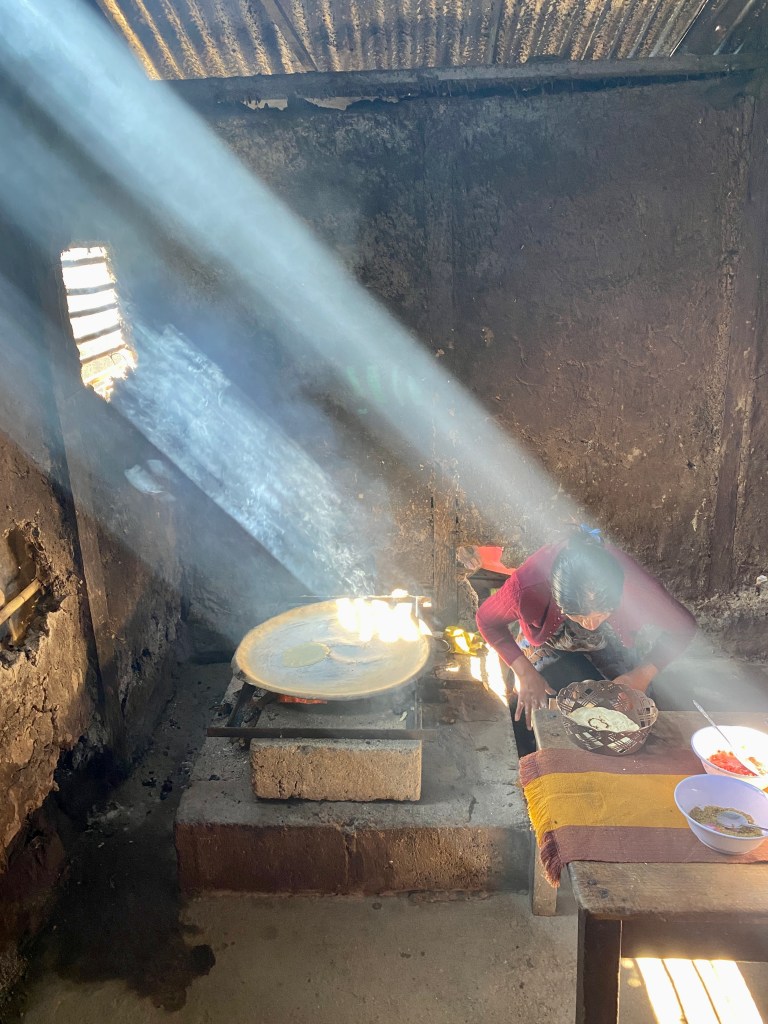
It was fine, but we didn’t buy anything. I asked the driver about the main square or the church and he made it sound it wasn’t worth it. I really wish we had walked around the square and looked at the other co-ops and different shops, as later on I found out there was a women’s textile co-op and there seems to be many more in the town.
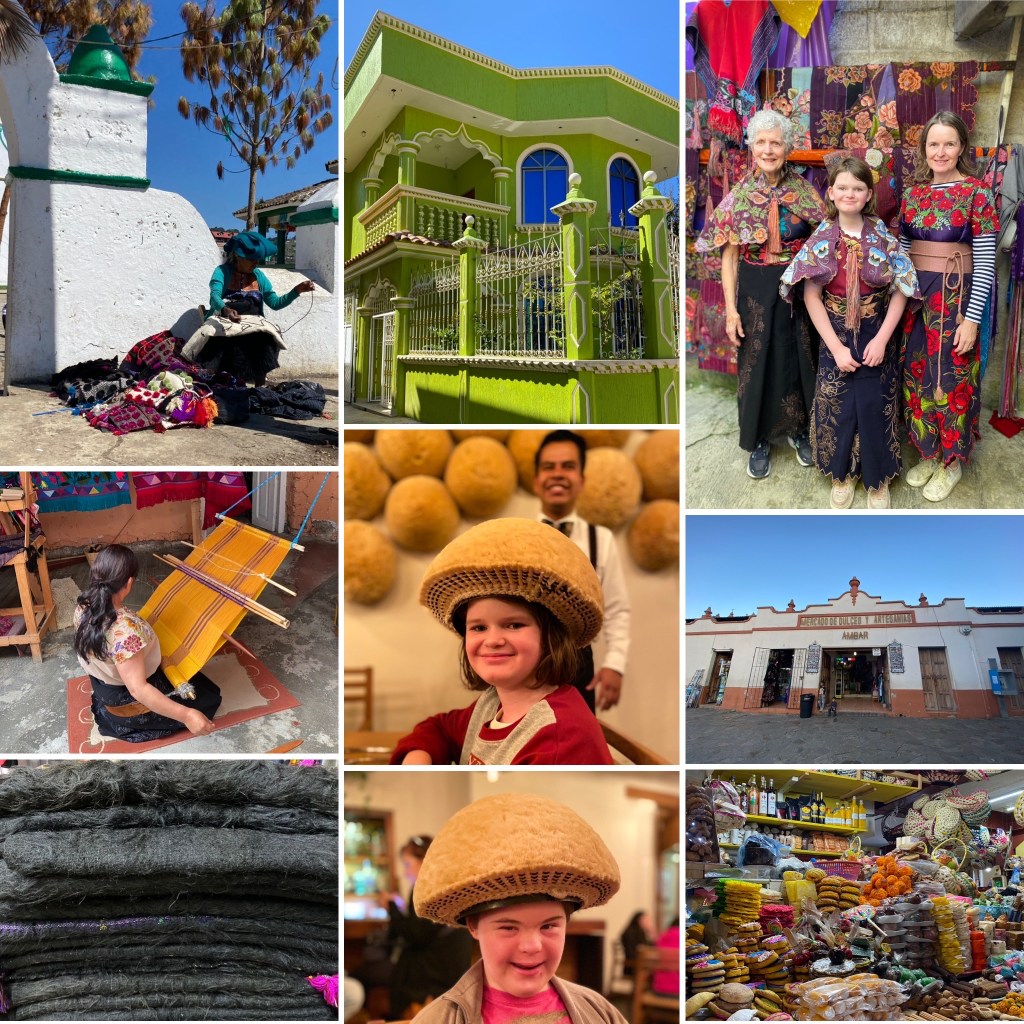
We went back to San Cris and walked up Real de Guadalupe where the kids had pizza. Then we walked over to to Mercado de Dulce and Artesania (it was ok but nothing special) we had a hot chocolate at Cacoa Nativa which was really good. I had wanted to buy some pottery at Artesania Carolina on the corner of Cristobol Colon and Real de Guadalupe, but it was closed. However, I weirdly found great stuff at a hole in the wall shop Artesanias Real 44. Two other really nice streets for walking and shopping are 20 de noviembre and Gral M. Urtilla. I preferred the latter for shopping. But again, wish I had spent more time in the market around the church.
We had an amazing supper at another hotel’s restaurant called El Secreto. Adults had duck tacos and the kids had burgers. It was really good food and nice, calming ambience. The waiters were so fun and when I asked what their wall art was (they are fuzzy traditional hats) he put them on the kids to try! We also bought delicious French pastries for the next day from El Horno Mágico Panadería Francesa.
I wish I had gone to the Centro de Textiles del Mundo Maya museum in San Cris. One more thing we didn’t see but I would check out if we went back are the Tonina pyramids (3.5 hours drive from San Cris).

Day 4
With our pastries, we were off at 8 a.m. We were seeing a lot of pottery on the road and so I asked the driver about it and he said if I could be super quick he would take me to a lady. So of course I promised I could be fast! He took us to Taller Artesanal Juana Gomez Ramirez, in Amatenango del Valle, who hand makes the jaguars you see in a lot of hotels and restaurants around Mexico. He said everyone was doing the typical pigeon, but she decided to do jaguars. They take weeks to make and paint as it is all done by hand with no forms, and some of them are bigger than an adult human. I bought many things and highly recommend making this stop! I noticed they had a pottery fair in the town 2-4 November 2023, so maybe worth bearing in mind if they have it every November. Her shop is just off the main road and her WhatsApp is +992 103 6042.
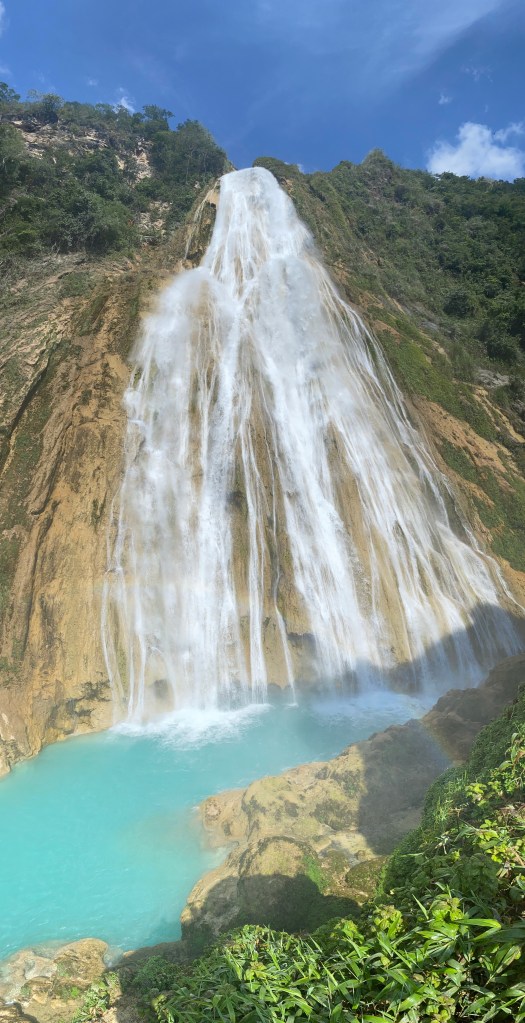
Next up was Cascadas Chiflon a waterfall (about $80 pesos pp to enter) with a 120m drop, but first we had breakfast outside the gate along the river for $600 pesos for six people. There are a couple of different walks you can do, we did the longer one (thought the short one on the other side of the river also seemed to end where we did so maybe you drive for longer? We couldn’t tell.) Ours was 2.4 km round trip and you could have an done an additional 1.4 km round trip extension, which we didn’t have time for. My husband, two children and my mother-in-law chose to zipline back! Prices ranged from $300-$600 pesos depending on how long of a zip you did. The pools along the path said no swimming, but everyone was wading in and they were shallow and would have been refreshing. There are about 756 stairs during the walk.
From there we drove to Cinco Lagos and Lagunas de Montebello (they are side by side) and on the way we drove past many fields of sugar cane. They burn the cane first, then cut it in long poles, then transport it on trucks to a roadside processing centre where they crush it. Roberto said they burn it first so the leaves don’t cut the workers bodies when they go in to cut down the poles of cane.

We were supposed to go horseback riding but we ended up going on a balsa raft across one of the lakes. As a Canadian I would not recommend the balsa rafting. It was not that interesting and it was on a small lake. Maybe if you haven’t gone on a canoe in awhile or you wanted a rowing experience it would be ok, but for us it was just sort of “what are we doing and how did we end up here” kind of experience. It was also getting late so we were doing it at dusk and arrived back to shore in the dark. And it wasn’t cheap either. The next day we saw on another lake kayaks for rent so I think that would be a much nicer option. However, we did eat at the parking lot in one of the local little cafes. It was very rustic, and we tried their typical dish which is cheese melted on a leaf with zucchini flowers. The ladies were doing their dishes we were so late, and they said they alternate days between other groups of women (or a man was coming the next day) and it was a coop of small basic grilled food.
We stayed at a simple cabin (5 Lagos) which Carlos our tour operator organized. It was very basic but the view was gorgeous! And it had a cabin for six people.
Day 5
We got up early and drove across the border to Guatemala. The border is manned by locals and it is in an indigenous area so we didn’t show our passports. It was fun to see the border over the river. There were a lot of kayak options here as well on Lago Tziscao. We had breakfast on the road at Comedor Giselle. It was pouring rain with a lot of fog, so we skipped the waterfall of the day which was Las Nubes and drove straight to Guacamayas. Along the way we saw orchards (well, clumps of trees on the hilly mountainside and realized they were rambutans!) We asked Roberto to stop at one of the stands and we bought a huge bag of them for $20 p for a kg.
We arrived at Lodge Guacamayas at 1:30 p.m. and while we were checking in the kids saw a baby and adult monkey swinging through the trees. We had a late lunch at the lodge — which had a wide variety of food to choose from and a nice restaurant on the river. We heard a lot of moaning, like a howling puma or some huge animal. We thought it was an audio recording to scare away while animals as it was always the same, then it would stop, and then start up again. Turns out it was howler monkeys! It was so fun to hear them there.
The lodge was really relaxing and a wonderful place to rest. We loved it there. They had cabins for 5-6 people which was great.
Day 6
We got up and took the first boat ride at 7 am from the lodge into the Monte Azul Reserve. Sadly, we didn’t see any guacamayas (parrots) as the best time to see them is June-first half of August, but it’s about 40C during this time and humid. However the second and third boats after us said they did see them. We did see crocodiles, a toucan, iguanas, many egrets, herons and king fishers, monkeys and we smelled for boars. The really fun thing about the speedboat ride is at the end there were these mini falls and he took them at a fast pace and we jumped the falls up onto the top part of the river, and then we had to jump them back down upon our return. None of us could believe he did it and we were howling with laughter. It was so fun. No one at Guacamayas speaks English, just local languages and Spanish.
After breakfast we drove three hours to Bonampak. It was a very bumpy road with zero services or cell service along the way. We were supposed to go to Yaxchilan (part of the Lacandona jungle) to see the mystical Mayan city but it was closed due to security issues, in fact the road there was blocked with sand bags and police were camping in tents in the roundabout leading to Yaxchilan.
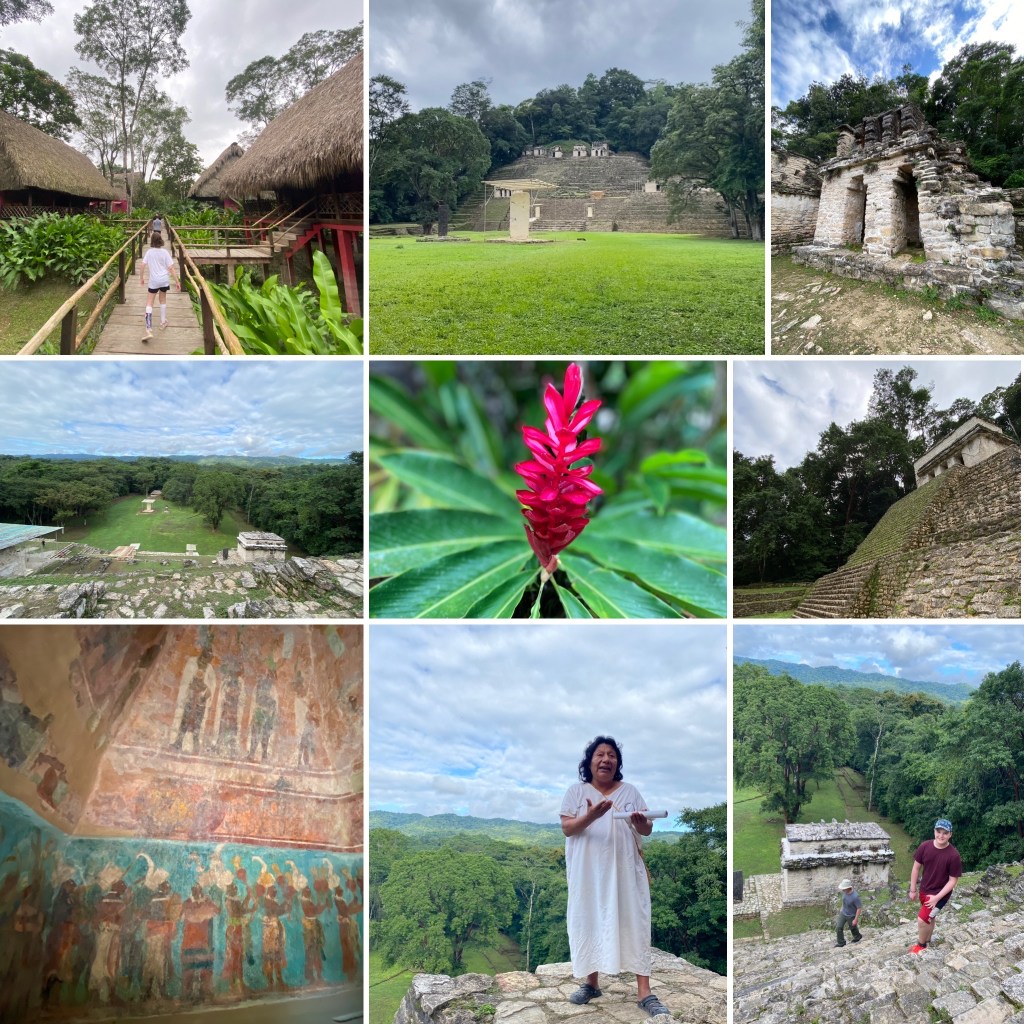
However we did go to the Mayan pyramids of Bonampek. It involved local drivers to take us down the road to the pyramid and a local guide wearing the traditional white Mayan tunic. He gave us a tour of the pyramids (we were the only people there) and he told us about their ball court, which every 52 years they played the ball game but with the ball on fire. Winners were sacrificed and losers were castrated. Men squeezed blood from their scrotum and women did the same from their tongues. We climbed the pyramids and saw the beautiful murals inside the three domes midway up the pyramids. They were so colorful and beautifully in tact. It was $1,200 plus tip for the six of us. We also bought a heavy, wonderfully carved wooden spoon from one of the women there.
We stayed at Cabañas Abel which was organized by the tour company. They were very rustic, but on a beautiful river with an outdoor restaurant on site. Camping available and river rafting.
Day 7
Basic breakfast at Cabañas Abel, but it was $525 pesos with tip for six people. We pre-ordered the night before, but still had to wait quite awhile. The coffee was good and slightly spiced, which was nice.
Our one child was sick so I stayed back with him while the others took a short drive to guided waterfalls and cenote. My husband said the guide from Cabañas Abel, Solarielcham Bor Yuck, was excellent and they enjoyed his tour a lot. The water fresh and the walk was easy to do.

At noon we left for Palenque. We were going to eat at a basic spot on the way but they were closed. Bring snacks! We ate at Maya Cañada and it was mostly tacos, very expensive and the food was ok. We went to our hotel, which was Hotel Villa Mercedes which was very nice. Kids had a swim and then a hotel supper of hamburgers. Roberto said Palenque basically was a ‘town’ the came into existence because of the pyramids and tourists, so the area where we had supper had two mini streets with restaurants and hotels and that was about it. Our hotel was on the outskirts and was really nice, we loved it.
Another thing we loved seeing along our drive was all the ‘gas stations’ which are jerry cans of gas sitting on makeshift wooden benches on the side of the road. Another thing to keep in mind if you decide to do the trip without a guide is to get gas every chance you can.

Day 8
We had the hotel breakfast buffet (didn’t compare to Marriott, but was good). Talked to Pancho the Parrot who had a big long conversation with us, check him out in the outdoor lobby, he was a lot of fun. We left at 8:30 am for Misol-Ha, a wide, long waterfall that falls into a perfect circle. It is also where they filmed Predator. It’s $10pesos per person to enter area the area, $20 pesos pp to enter the actual waterfall of Misol-Ha. We just went down to the side of the waterfall, the path was slippery due to the water splashing from the waterfall. No one was there when we were there and it took us half an hour to go up beside the bottom of the falls and back. It was closed to go behind it. You could also do a hike to the top and back for a really pretty view, and there was a man offering a guided hike for a fee, but it was going to take 1.5 h to hike to top and back so I decided not to as not all the kids could do it.
By 9:40 we were driving to the other Alien v. Predator movie location, otherwise known as Agua Azul, and we arrived within the hour. On the way little girls were on the side of the road, maybe ages five and eight, and they pulled a rope across when they saw us coming so they could sell us plantain chips! They were so adorable, the little scallywags! So of course we bought some chips off them and their plan definitely worked!
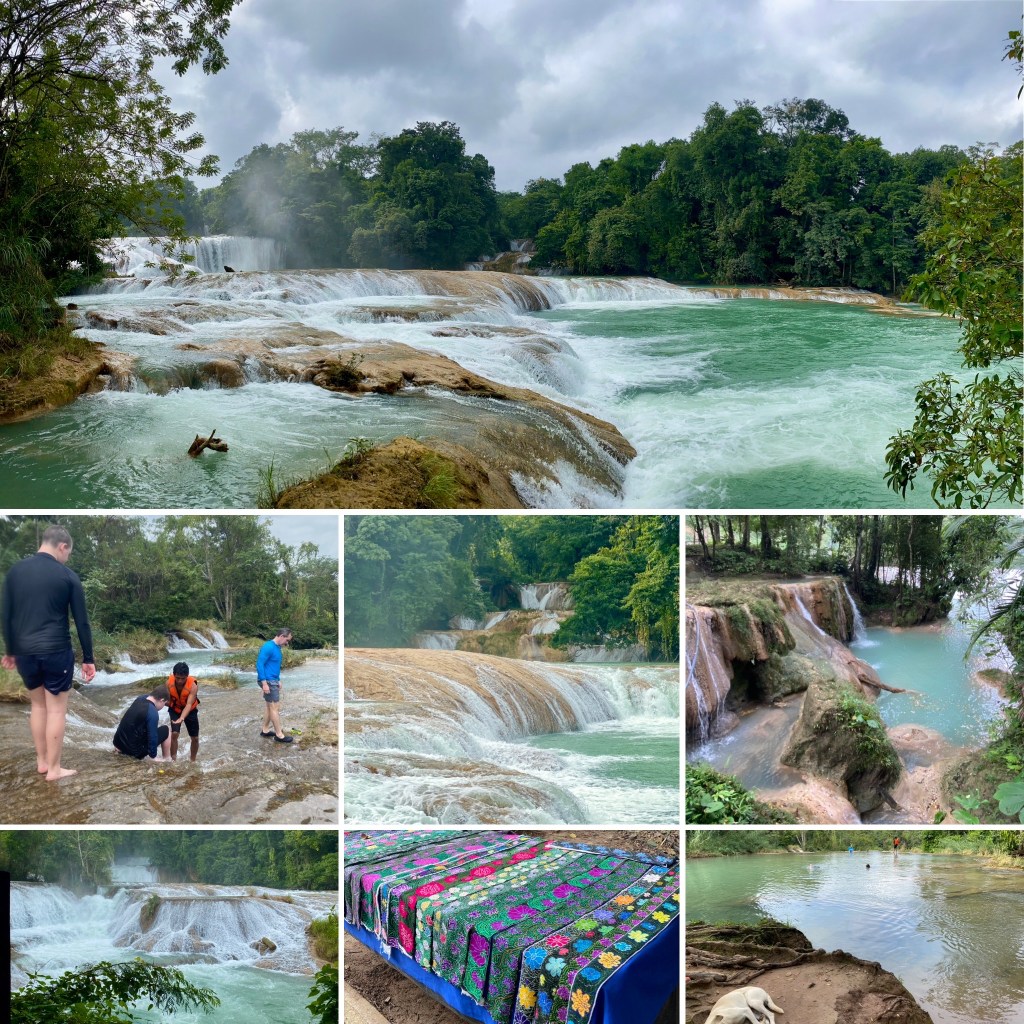
The falls were long, and low with multiple pools and layers with such green and vivid blue! The photos of the waterfalls that you see are taken by locals when the water is low, so it was impossible to walk out into the middle of them. There weren’t many people at all when we arrived at that hour. There are two areas to go swimming. We went to the top area and a local guide showed us where to dive and jump in safely and he took our phone and took photos and videos (for a tip) he spent so much time with us and was so great with the kids, he was just lovely. There was really good local crafts shopping here and when you catch a glimpse of the homes behind the shops I was really happy to support their economy. (hahahaha!) We ate at Charly’s (across from the bathrooms at the entrance) which was a very popular spot. We had fish and shrimp and the food was fast and good and reasonable. We left at 4 p.m. for the two hour drive back to Palenque.
While driving we also saw huge knubby balls of palm fruit for palm oil. They are about the size of a soccer ball, which they take off the husks and there is the palm nut inside. We saw the trucks full of them and the mini, local processing plants on the side of the road (very rustic) just like the cane sugar).
I didn’t have time to check out a textile museum in Palenque which is the Museo del Textil Lak Puj Kul.
Day 9 Last day
Our last day in Chiapas and we saved the best for last. We went to the pueblo magico of Palenque and we were at the archeological site at 8:30 a.m. We decided to do the jungle walk (it was about $1,200 for a short tour of $2,600 pesos for the six of us for jungle and pyramid tour). You can book a guide in the carpark. We saw a little capybara snuffling in the woods, so that was cute and we heard the howler monkey again howling at another group of monkeys — the guide said they are territorial for the fruit and they are howling to say “don’t eat this fruit, I’m here with my family.” We heard a toucan, we tried out a Tarzan vine (which one of our members broke! Not me….) The guide said May is the best time to see the animals. He did all our birthdays of the Mayan calendar which was fun, our eldest was King of the Water, youngest has balance of intellect, mother-in-law was visual, husband was serious and profound and I was the monkey (sigh). But also “covers a lot and takes a little” so maybe I’ll go with that definition! The kids loved that part. We sniffed out rotting smells which was a boa constrictor laying eggs. By 10:15 we had finished our walk. The children liked it and it was not difficult as it was basically just off the parking lot. Having done walks in the Ecuadorean jungle in the middle of nowhere I hesitate to call it a “jungle walk” but it was a walk in the woods and it was interesting. I wouldn’t have done it if I didn’t have kids.
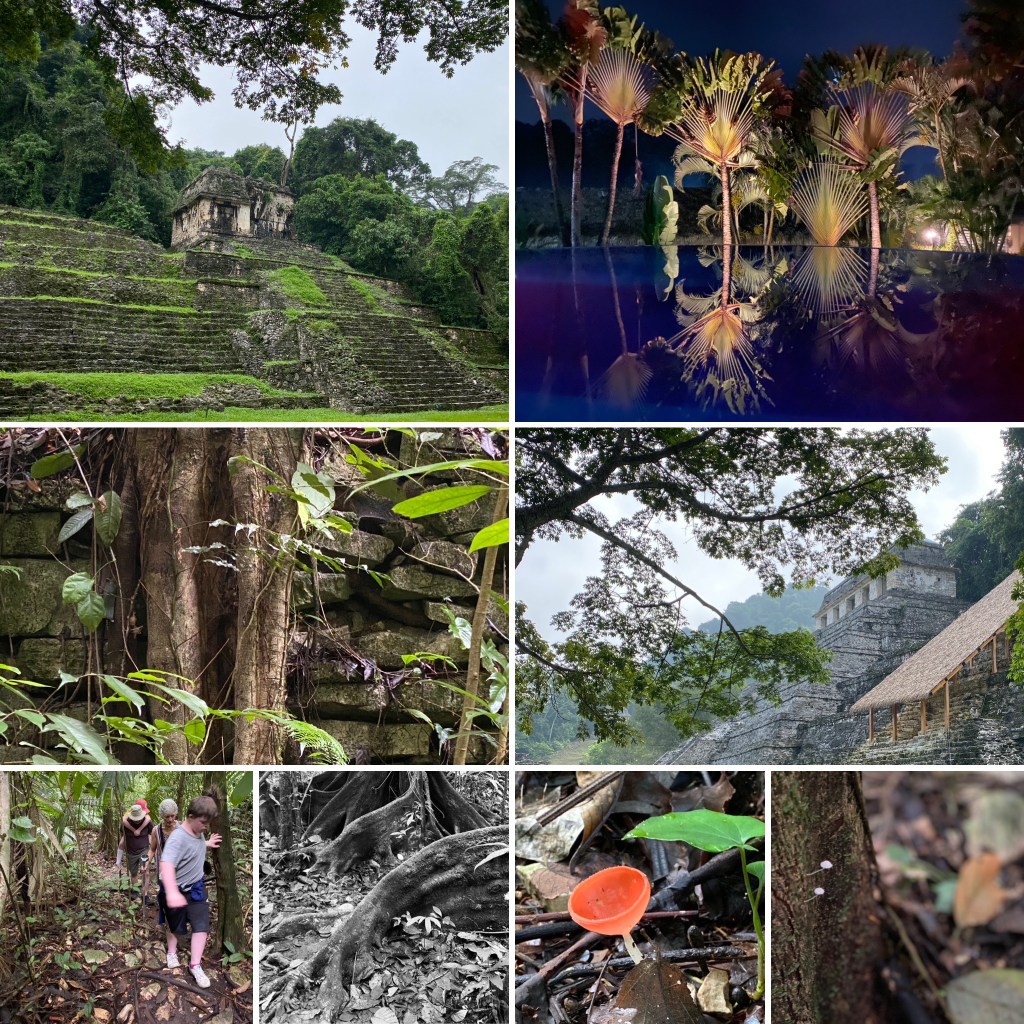
We then entered the area where the pyramids are, which are over 20 km so only about five per cent is open or exposed, as most is still hidden under jungle. Now they use infrared drone cameras to see where the pyramids are, so who knows what majestic gem is hiding under ropes of jungley trees. Palenque was from 100 BC to 900 AD, the pyramids are 40/60 reconstruction to original. The Great Temple held hieroglyphs which told the whole Mayan story. There was a very small ball court, and they also lit the ball on fire like at Bonampak.
My in-laws were in Chiapas, as I mentioned, so long ago and my mother-in-law didn’t recognize any of the first three massive structures. Then the guide said they were uncovered in the 1990s, so we realized they were all covered with jungle when she had been there, so that’s why she didn’t recognize it! She said there was just a road and some pyramids, no one around, no carpark, no tourists.
There are ramps the whole way up and it was quite wheelchair/stroller friendly. We were finished by 1 p.m. It was so boiling hot and muggy by then we were all really glad we had gone early. And there were a lot of tourists entering in at this time too. I think the earlier you go, the better.
We went back to Palenque and we had lunch at Kinich Kan balam, which had great drinks, delicious food and a nice variety with really good service and prices. And we saw an iguana in the tree at the back by the pool! (It’s also a hotel.)
Fly out of Villahermosa.

What to bear in mind
- For most days we had zero data and phone service. Even wifi at most places was only in reception and very slow. So if you are driving you need to know where you are going, and be prepared. We were glad we were with an organized tour. Afterwards we found out two days after we had driven through one of the towns, there was a kidnapping and people were injured and killed. It was targeted and happened at night, but we were happy that we were not driving ourselves.
- Most guides only spoke their native language and Spanish. Very little English.
- Bring snacks or buy them when you can, and buy water when you can. You don’t know when the next spot to purchase these will be.
- You need sunscreen and bug spray
- Bring plastic bags for wet things
- Dress in layers. I wore T-shirt and shorts. Puffer coat and sweats. Raincoat. Sun hat, sneakers and water shoes.
- The drivers and other guides all said that Jan to April are the best times to visit, but it’s 40C plus and humid. We found November to be great weather-wise. May-June-July are the hottest. Another tour guide friend said Easter and November are good times to go.
- Take cash and use your credit card when you can. I tried to include the prices so you get an idea of how much cash was needed. We also had to tip all the guides, the boats, and then our driver at the end. My husband guesstimates we spent (with six of us) $10,000-$12,000 mexican pesos cash during the tour (not including pre-booked/paid tours or hotels or things we could pay with credit card).
- In our group we thought the highlights were Chamula, Guacamayas Lodge, Bonampak, Palenque, a day in San Cristobal, Misol-Ha and Agua Azul. Children said the zipline and the Marriott buffet.

 Come From Away
What a great writeup! I like the way you grouped the pictures.
You got everything and I even learned some facts I hadn’t caught in Spanish.I can see why its good to write it soon after the trip.
(I saw one typo in the sections of the church at Chamula ”a man was kneeled”)
>
LikeLike
This is a great post – super helpful for planning a diverse trip to Chiapas. Thank you for sharing!
LikeLike
Thank you! I hope you enjoy it as much as we did. You should always check travel advisories as they change frequently.
LikeLike